
Brief Historical Overview
About 15 years ago, we witnessed the advent of MEF (Metro Ethernet Forum), which undertook a progressive effort to standardize and organize data transport service techniques based on the Ethernet protocol. Several years have passed, and today we have a comprehensive compendium of standards that define what is known as “Carrier Ethernet Services.”
MEF has defined Carrier Ethernet as “a ubiquitous, standardized, carrier-class service and network, with five central attributes that distinguish it from familiar LAN-based Ethernet: Standardized Services + Scalable + Reliable + Manageable + Defined by Quality of Service.
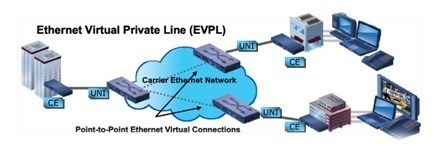
MEF has also defined the basic components of the Carrier Ethernet service. The most widely used to date are the so-called E-Line, which serve as “layer transport links” between two endpoints and can be either “physical” or “virtual” (Ethernet Private Line or Ethernet Virtual Private Line, respectively).
The underlying idea of these forms of Ethernet services is that regardless of which physical mechanism performs layer 1 data transport, at the link layer a “ubiquitous Ethernet” emerges. This is characterized by being a collection of “Ethernet virtual circuits,” or “EVC,” and two UNI interfaces at the endpoints, which serve as ingress and egress.
The Current State:
MEF in those early standardization steps also defined the “generalizations” of Ethernet services, such as “E-Access” and “E-Transit.” These models fully incorporate the concepts of network boundaries, carrier concatenation, and the complete commercial chain of service (wholesalers, regional providers, local carriers).
Currently, operators are gradually transforming their networks to these more advanced forms of organization. In this “current vision,” not only is the goal to achieve a unification of all physical data transport methods, but there is also a need to reconcile and unify quality of service criteria. These criteria are currently not fully unified.
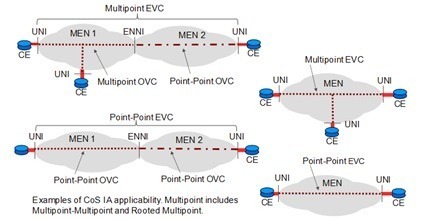
In these service models, concepts of best-effort Ethernet services can definitely no longer be used. MEF has created several “key performance indicators” or “KPIs,” with which to define and measure compliance with these services for certification purposes. The ultimate objective is to ensure “ubiquitous service availability” in the deployment region. In this region, of course, we will find potential commercial users to whom we can offer connectivity services.
The first observation is that the problem of unifying quality of service criteria is complex. By way of example, we mention the so-called “Class of Service Performance Objectives” (or CPOs). These parameters require “CoS Labels,” which allow the EVC to be identified and its quality to be characterized end-to-end. This implies potentially reaching agreement between multiple parties…
What is MEF 23.1?
MEF 23.1 Class of Service Phase 2…This standard specifies 3 CoS models, which we call “H,” “M,” “L,” and we apply them to both UNI and ENNI. We see that it is nothing other than the idea of maintaining end-to-end quality of service without detriment to those operating the “commercial chain” (operator, carriers, third parties, etc.). It sets recommended values for Frame Delay, Mean Frame Delay, Inter-frame Delay Variation, Frame Delay Range and Frame Loss Ratio, called CoS Performance Objectives (CPOs).
These initiatives aim to clarify quality of service compliance responsibilities:

How do we implement them? Definitely, these are initiatives that require strong cooperation between operators so they can facilitate and share information from end-to-end of the service. It requires, for example, that they agree on (1) a CoS mapping, and (1) an EVC labeling scheme. For example: at a given ENNI we could have a P/S/H/C scheme (left) that must be mapped with a (R/P/S) scheme…

Currently, there is a prevailing trend for the parties to generate a bilateral agreement between ENNIs. Regardless, we may also find another agreement at the UNI level (operator with customer)…this situation can lead to potential inconsistencies in managing the end-to-end Ethernet circuit quality. That is, the customer could encounter inconsistent and erratic performance. Clearly, if the customer runs services that are based on providing audio/video in real time…then potential Quality of Service problems may arise. These problems can trigger multiple complaints and claims from end users…we are talking about quality of service as perceived by the end user (QoE or Quality of Experience).
The VIAVI Testing Proposal
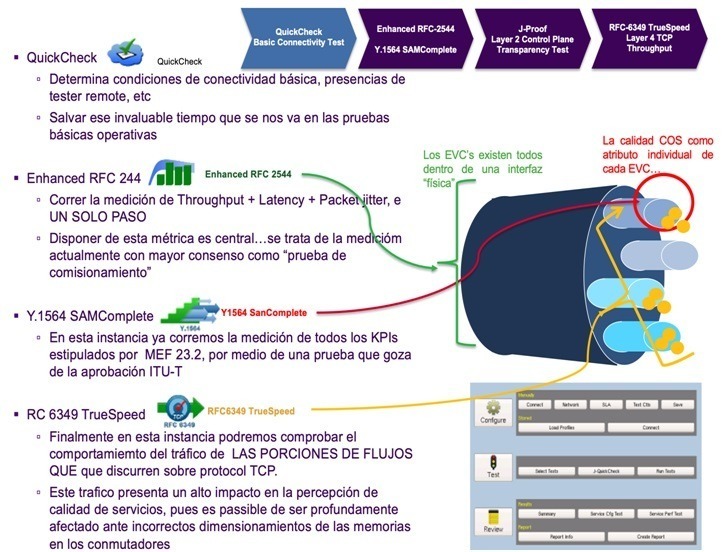
Over time, the industry has presented testing options that gradually increased the degree of certainty regarding Ethernet service quality. The “essence of Ethernet service activation tests is summarized in 5 concrete tests, which are supported in our family of ultra-portable traffic testers, called Viavi MTS-5800:
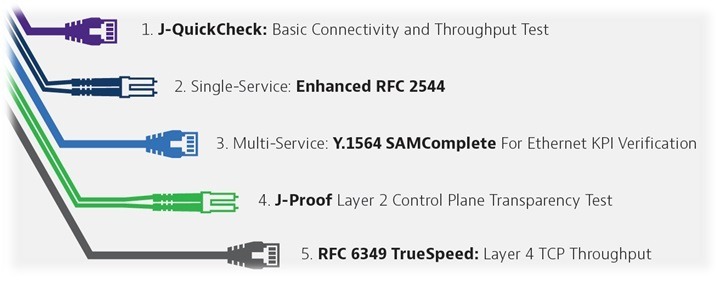
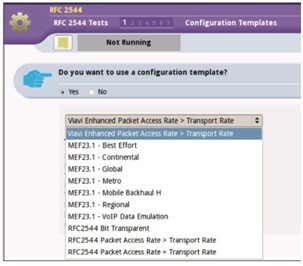
In this regard, for RFC2544 and Y1564 tests, we have included “presets” of quality objectives standardized by MEF 23.1. In this way, the user can leverage MEF recommendations to determine service compliance (pass/fail verdict).
On the other hand, it is quite possible that the service has not been defined according to MEF 23.1 KPI objectives. In this case, we still recommend using the MEF 23.1 mask…it will give the user a valuable “first guide” that will help or facilitate in determining particular pass/fail objectives.

We conclude the presentation by offering a description of the purpose of each test and how they relate to the various traffic or service portions found at a test interface. The philosophy is, as always, to follow a logical test flow…test first the most critical functions at the operational level, then proceed to test the final services, each with its particular characteristics and types of impact.
For more information, please contact us at ventas@tecnous.com
Author: Eng. Emiliano Alaimo, Product Manager, Tecnous SA